Showing posts with label binghamton. Show all posts

Monday, August 26, 2013

Finite fossils, energy poverty, and other benchmarks


I will be mostly off line through Labor Day as I attempt some vacation time in northern New York with family. Upon my return, I expect to follow-up with a post about the status of natural gas infrastructure in New York, and another about highly-anticipated health studies that are purportedly key to the outcome of the shale gas decision in New York.

Meantime, I offer some raw material for reflection through a very wide lens. First, a quote, cited in my last post by President Obama during his visit to Binghamton last week:

The bottom line is those (fossil fuels) are still finite resources.  Climate change is real.  The planet is getting warmer.  And you’ve got several billion Chinese, Indians, Africans and others who also want cars, refrigerators, electricity. And as they go through their development cycle, the planet cannot sustain the same kinds of energy use as we have right now.  So we’re going to have to make a shift.

Second, a short film from a fracking skeptic about renewable energy development in parts of the developed world and Germany in particular. It’s part of a series called Shale Gas Stories by Kirsi Jansa, an independent film-maker.


Third, a clip from a multi-media project depicting energy poverty – the term for the abject absence of fundamental resources, mostly in undeveloped countries -- by Peter DiCampo, another independent filmmaker. DiCampo’s work, title Life Witout Lights, makes tangible an idea that is mostly a distant abstraction for many of us who never have lived long without power at our fingertips.


I find each of these perspectives compelling and provocative in its own right. Collectively, they provide no outline or theme that suggests a broad and simple answer, but they give plenty to think about.

Tuesday, August 20, 2013

Obama’s NY/Pa tour raises profile of Dem’s and fracking Cuomo’s cautious approach contrasts president’s action

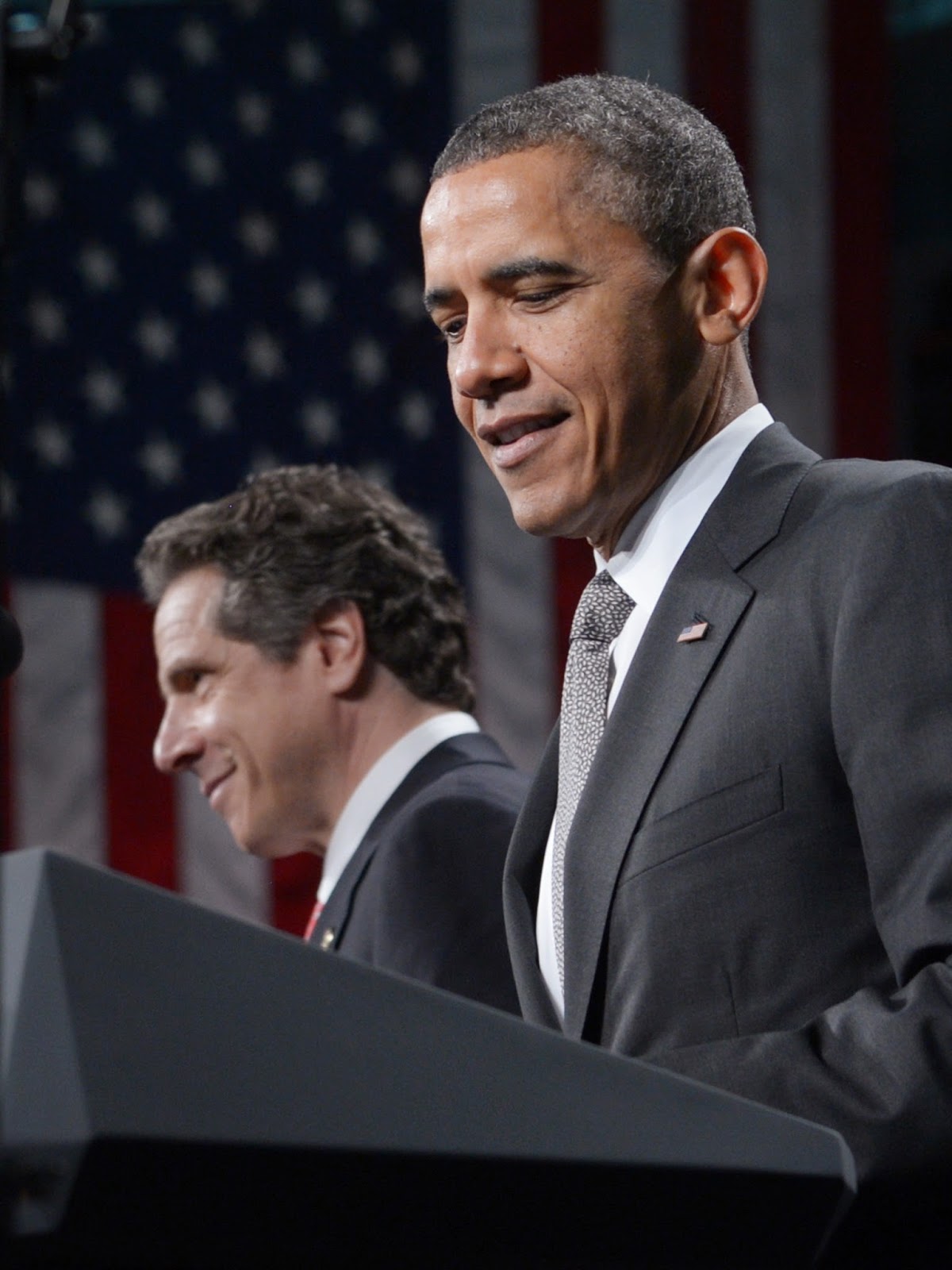
Governor. Cuomo and President Obama
PHOTO GETTY
This week President Obama will travel across upstate New York and Pennsylvania with a message of support for the working class. His shirt-sleeves bus tour takes him across contested territory – the Marcellus and the Utica shales – two of the world’s largest shale gas reserves, which extend under both states.

Obama is scheduled to visit Buffalo, Syracuse, and Binghamton before heading into Pennsylvania as he pitches his vision for rust belt revival. While energy development is not billed as a focus of the trip, it’s implicit in many of the political issues the president faces, ranging from foreign affairs to jobs to environmental preservation and public health. Obama will tour a region that has been split by the controversy over the role of fossil fuel development and fracking in particular in all of these issues. The splits, locally and regionally, tend to travel along ideological lines, and the differences between New York and Pennsylvania represent high-profile examples.

Pennsylvania Governor Tom Corbett, a Republican, has enthusiastically embraced shale gas. Accordingly, Pennsylvania has been held up as an icon by both supporters and critics of all that is good and all that is bad with a shale gas boom. New York Governor Andrew Cuomo, a Democrat, is not so enthusiastic. His Department of Environmental Conservation is yet to complete a policy overhaul necessary for high volume fracking to begin in New York. Lacking this document, Cuomo has effectively extended a moratorium for permitting shale gas wells – now entering its sixth year -- while his administration considers whether the health and environmental risks outweigh the rewards. This moratorium has become a showpiece for the anti-fracking movement, and those who believe that the pause is just what is needed for the nation to begin shifting to renewable sources.

Obama supports shale gas development as a means of energy independence and, according to his line of politics, jobs for the working class, and his policy decisions reflect this. In sharp contrast to Cuomo’s cautious approach, Obama’s EPA has recently dropped investigations in Pavillion Wyoming and Dimock, Pennsylvania (which is not on the president’s list of stops). In both locations, the EPA staff had documented ground water pollution from chemicals associated with nearby shale gas development, but aborted plans to trace the pollution to its source. Obama’s administration has also begun to permit natural gas export facilities, which will increase markets and encourage more exploration and development of domestic shale gas reserves.

Cuomo is widely cited as a potential standard bearer for Democratic party’s future. The New York governor’s differences with the president over fracking as a fundamental tool for economic revival are worth paying attention to this week. The president’s detailed itinerary is yet to be released. We know that the governor is scheduled to greet the president when he arrives in Buffalo, but has no plans to accompany him further.  While it is tempting to read much into that, the shale gas issue is surely one of a legion of factors that come into play here.

Meantime, protestors have been busily organizing to make their presence known at the presidential stops. Those on either side of the issue see this rare confluence of national and state agendas on local ground as opportunity to push their own visions. And isn’t that American politics at its best?