Showing posts with label sautner. Show all posts

Saturday, January 25, 2014

Solutions to H20 pollution elude officials in Cabot gas field Five years after blast, Pa officials continue tests in Dimock

Five years after the explosion of Norma Fiorentino’s water well signaled all was not well in Cabot’s Marcellus shale gas operation in northeast Pennsylvania, state environmental officials are still trying to gauge the impacts of drilling on the water supplies of local residents.

The agency is scheduling another round of tests to see whether methane levels in Dimock water wells are safe, Colleen Connolly, a spokeswoman for the Department of Environmental Protection, confirmed this week. It's the latest step in an investigation that literally began with a bang on New Year's Day, 2009. The explosion of the Fiorentino well prompted an investigation by the DEP that concluded water wells serving at least 19 homes contained explosive levels of natural gas that had migrated underground from Cabot’s nearby drilling operations.  Since then, dozens of water wells in Susquehanna County have been taken off line due to methane contamination.

Some of the Dimock residents agreed to a settlement with Cabot, negotiated by the DEP, that compensated the parties with payments worth twice the assessed value of their properties, and systems to filter their water. Others have held out. They believe the systems, which require maintenance, are not an effective answer to the problem and do not filter other harmful chemicals associated with drilling. The settlement was finalized in 2010 under DEP Secretary John Hanger (now a gubernatorial candidate).  Hanger, who headed Governor Ed Rendell’s DEP, had originally pushed for an $11 million infrastructure project, to be paid for by Cabot, to restore fresh water to the residents. Cabot opposed the plan for a water line, and the administration withdrew it soon after Tom Corbett, an industry supporter, was elected governor.

Although Cabot continues to develop the Marcellus Shale throughout Susquehanna County, the DEP has banned the company from drilling within a 9-square mile area around Carter Road until it fixes an unremitting methane problem there.

Working with the settlement as a blueprint, Cabot has restored water to some but not all homes through special filtration systems or bottled water. But problem areas persist. Several polluted homes have been abandoned, including two on Carter Road bought by Cabot. The company bought 1101 Carter Road, once home to outspoken fracking activists Craig and Julie Sautner, and demolished the ranch house last year. It then sold the vacant parcel to a neighbor for a fraction of the purchase price, with a condition written in the deed that no residence could ever be built there. Late last year, Cabot bought the home of Mike Ely, on the south end of Carter Road, although the company has not answered questions about its plans for the contaminated property.

Several other homes in the area remain vacant after having been sold to other parties, reportedly for interest in mineral rights. Three vacant homes happen to be near Cabot’s failed Costello gas well, which officials have indentified as a possible source of methane pollution.  This week, Connolly reiterated that the Costello well, near the intersection of the south end of Carter Road and State Route 3023, was “unviable” and “”remedial work is continuing at the gas well, and Cabot and DEP continue to evaluate results at the water wells.”  In addition to fluctuating methane levels, previous tests have shown levels of iron and manganese that were elevated but within standards in some water samples. Elevated levels of these elements are “not uncommon during gas migration,” she reported.

Before Cabot can resume drilling in the banned zone, Connolly said, the company must “demonstrate compliance” with the 2010 Consent order. “We have scheduled another round of testing to determine whether the gas migration event has ceased,” she added. Connolly could not immediately say how many homes will be included in the sampling collection. Sources in the field told me that the DEP plans to test all 19 homes listed in the consent agreement, but that the agency has not been granted access to all the homes.

As I have found with many stories about shale gas, a central problem is a lack of information. Some of this is because state regulators, dependent on updates from companies that are exempt from many disclosure laws, are still trying to figure out exactly what is going on. And some of it is due to the fact that companies are reluctant to share certain information that casts operations in a negative light. This is all complicated by some residents who feel what is happening on their property is their business, others who want to show the world what they want the world to see, and still others working in good faith to expose and understand problems with the intention of making things better. In short the problem is cast in a muddle of projections from stakeholders with widely divergent interests and ideological footing. Chief among these is Cabot, which possesses the facts about what is happening at its restricted sites and underground, test results, along with rights to the land under question.

In addition to speaking with Connolly and people in the field, I have called and emailed Cabot spokesman George Stark over a period of months for an update. Here is one of my email queries from Dec. 10. 2013:

Hi George,
I’m following up on Cabot’s recent purchase of Mike Ely’s property on Carter Road and have some questions related to that:
Why did Cabot buy the property? 
What plans does the company have for it?  
What is the status of the nearby Costello well? Is it all fixed?
Does the company expect to be able to resume development in the 9-square mile “no drill zone”?
Also, a question related to the former Sautner property now owned by the Mayes: Why did Cabot forever prohibit building a home on the property as part of the land covenant?
 Here is Stark’s response, which came a month later, on Jan. 9, after I left several phone messages:
Tom,
Got your message yesterday about the former Ely property. 
Cabot entered into a private business transaction with the prior owner of the property. The sale was agreed to by both parties and we are now the current owners. 
George

Trying to apply his answer to the questions at hand in any meaningful way was fruitless, so I emailed Stark again:

Hi George 
Thanks for responding. But your statement does not answer any of my questions. Here they are again: 
Why did Cabot buy the property? 
What plans does the company have for it? 
What is the status of the nearby Costello well? Is it all fixed? 
Does the company expect to be able to resume development in the 9-square mile “no drill zone”? 
Also, a question related to the former Sautner property now owned by the Mayes: Why did Cabot forever prohibit building a home on the property as part of the land covenant?

That was January 9. Since then I have also left voicemails. I am still waiting for a reply. If Stark’s response, or lack of a response, has any journalistic value in the meantime, it illustrates how some companies deal with these kinds of unpleasant questions. They ignore them, or offer a statement of fact that appears to be authoritative but is actually irrelevant.

There are people on all sides of the debate over the merits and risks of shale gas development who share a sense or frustration over lack of information. A group of drilling proponents called Dimock Proud has been especially critical of the DEP for implementing the no-drilling zone in Dimock without engaging all the people who live there, including those eager to see shale gas development proceed. In their view, the DEP has been operating too much out of the public eye. The group represents people who are in position to make money when Cabot drills on their property. The Dimock Proud web site features letters to the DEP complaining that the agency has ignored their requests for information -- specicially, explanations of the no drill zone around the problem wells and why the ban applies to people in the 9-square mile area who want to see their shale gas developed. The group stresses this compaint:

Dimock landowners have written you countless letters, signed petitions that we sent to you, and absolutely begged you to let us out of that arbitrary 9-square miles. You did nothing! You didn’t even acknowledge receipt of the petitions.

The controversy over drilling and fracking in Dimock is one of many in countless communities in dozens of developing shale gas basins across the country. Some problems are unique and some universal. But Dimock, just across the border of New York State, was one of the first where the media spotlight focused intensely on the gas boom that is transforming the country. And given the persistence of problems there, it's where it might also shine the longest.


Friday, November 22, 2013

Cabot buys second polluted residential property in Dimock 12-acre parcel on Carter Road flanked by faulty gas wells


The former Mike Ely propety, now owned by Cabot
Cabot Oil & Gas has closed a deal for a second residential property affected by chronic methane pollution in the heart of its prolific gas operations in Susquehanna County, Pennsylvania.

The Texas-based company paid Michael Ely $140,000 for the 12-acre property that includes a doublewide modular home, according to records filed in Susquehanna County Courthouse Wednesday.  The property – now vacant -- borders the intersection of the south end of Carter Road with State Route 3023 in Dimock Township.

The state Department of Environmental Protection has identified at least two malfunctioning gas wells operated by Cabot bordering the property, including the Gesford 3 well, several hundred yards to the north off Carter Road, and the Costello 1 well, just to the south off Route 3023.

Cabot demolished the former Sautner in September 
The agency has forbidden Cabot to drill more wells in a nine-square mile area around the intersection until the company resolves problems with these and other shale gas wells that – according to the DEP inspectors – are causing methane pollution.

The former Ely property sits less than a mile south from another polluted residential property on Carter Road that Cabot bought for $140,000 from Craig and Julie Sautner last year. Cabot demolished the three-bedroom ranch in September and sold the empty lot to a neighbor for $4,000. The new deed includes a clause – called a land covenant -- that forbids residential dwellings on the property.

Cabot bought both the Sautner and Ely properties through a subsidiary called Susquehanna Real Estate 1 Corp.

Ely ancestral home across from Cabot's newly acquired lot
The former property of Mike Ely is part of a larger swath owned by generations of the Ely family since 1858. Bill Ely, Mike’s father, lives in the family’s large ancestral colonial home near the banks of Burdick Creek, which runs under a bridge connecting Carter Road with Route 3023. Bill Ely and his wife, Sheila, are among families in the area that depend on bottled water. Bill told me he has no intention of selling his 19th century house to the company, even though his water is not drinkable.

“I’m not leaving” Ely said Thursday. “My family’s been in this home for generations.”

Susquehanna County and operations centered in Dimock have been the source of both boon and bane for Cabot, which in 2013 was the second largest natural gas producer in Pennsylvania behind Chesapeake Energy. In the first half of the year, Cabot had 15 of the top producing wells in the state concentrated in its leasehold in Susquehanna County – an area experts call a “sweet spot” for Marcellus Shale production. But production has been beset by problems. Both Mike and Bill Ely were among more than 30 families in the area that settled a law suit with Cabot for damages related to water pollution for an undisclosed amount in 2012. The controversy continues, as Cabot, under the watch of the DEP, attempts to fix problems that have prevented it from drilling any new wells in a 9-square-mile region around the Carter Road area. Some of the gas wells have been plugged or shut down, so residents living over them have seen royalty payments dwindle.

Hazards found in some residential water wells include methane, arsenic, bacteria, and various heavy metals that occur naturally. Methane can make water flammable and pose risks of explosion in wellheads and enclosed spaces. Arsenic, heavy metals, and bacteria can cause illness. Drilling can open pathways that allow contaminants to move through the ground, but the extent to which this happens is open to scientific and legal interpretation. Cabot continues to challenge the DEP findings publically with claims the contaminates are a result of naturally-occurring phenomenon.

The DEP began investigating problems in the region after a residential water well on the north end of Carter Road exploded at the home of Norma Fiorentino on January 1, 2009, shortly after Cabot began ramping up operations to produce gas from the Marcellus Shale with the controversial practice of horizontal drilling and high volume hydraulic fracturing. Since then, the area has been the focus of a national controversy over the impacts of shale gas development on residential communities.

During my visit to the area this week, I noticed that a service rig at the Costello gas well had been removed. George Stark, a spokesman for Cabot, was not immediately available for comment about recent developments. Stark told me in September that the rig, which has been at the site for months, allowed crews to “monitor” the casing of the gas well, which appeared sound.

DEP officials explained it differently. They had not pinpointed a source for the problems affecting three homes near the well, including the Ely properties. But they had determined that the suspect Costello gas well was "unviable" and would have to be plugged. In an email response to my query earlier this fall, DEP spokeswoman Colleen Connolly reported that Cabot was ”continuing remedial efforts” at the Costello gas well and “evaluating the effectiveness” of the work.  Methane levels were fluctuating, she said. Additionally, tests had shown levels of iron and manganese that were elevated but within standards in some water samples. Elevated levels of these elements are “not uncommon during gas migration,” she reported.

Update 5:25 p.m. EST. In response to my request for an update this week, Connolly said in an email this afternoon that “remediation work” is continuing on the Costello 1 well.  But the department’s characterization of the status of the well remains vague. In Connolly’s words, the well is "essentially unviable," but DEP officials are "not aware of the gas well having been officially plugged.”


Tuesday, October 22, 2013

The razing of 1101 Carter Road: The rest of the story… Land “covenant” in deed forbids “human habitation”

The Sautner home became focus of the antifracking movement
PHOTO JAMES PITARRESI 
When I last visited Carter Road, a contractor for Cabot Oil & Gas was demolishing the former home of Craig and Julie Sautner, the anti-fracking activists who had relinquished their three-bedroom ranch as part of a settlement with the Texas drilling company. This was part of a larger dilemma in their hometown of Dimock, Pennsylvania, where the Sautner’s water well was polluted by nearby Cabot drilling operations, according to records from the state Department of Environmental Protection. It’s a charge that Cabot has denied publically and settled privately – with the Sautners and dozens of other plaintiffs.

The Sautner property – adorned with anti-fracking posters and inhabited by some of the most vocal and visible of fracking critics -- had become a particular symbol of the tensions that divided the community. Julie and Craig were featured in various high-profile accounts of the conflict as either victims, heroes or phonies. The aquifer that provided water to their home on 1101 Carter Road, and to 64 other homes in
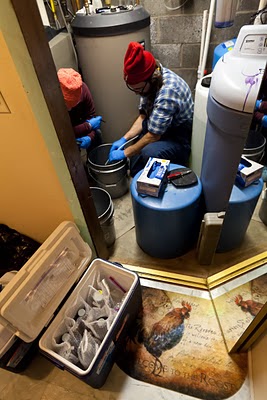
EPA tecs sample water at Sautner home in 2012
Photo: JAMES PITARRESI
the area, was the focus of a controversial EPA investigation that found pollution at levels posing safety threats in 8 percent of the wells. Instead of making recommendations, the federal agency deferred to the industry’s solution, approved by the state, which was to deliver water in bottles and tanks to affected homes and provide filtrations systems. The Sautners and some other residents found those measures ineffective, and they unsuccessfully pursued a water line from the nearby village of Montrose – a measure that would have cost Cabot more than $11 million.  (A more full account of that story here.)

As part of an eventual settlement, the Sautners sold their property to a Cabot subsidiary for $167,500. Cabot demolished the vacant house, company spokesman George Stark told me after my visit last month, because the company was planning to sell the property, and it was more marketable without the
structure. Yet that answer doesn’t square with information on a deed that has since been filed in the Susquehanna County Court House in Montrose. After demolishing the house, Cabot sold the 3.3 acre parcel to Tim and Debbie Maye – owners of an adjoining property -- for $4,000. (Perhaps the absence of the house is an asset to Cabot, which retained the mineral rights on the Sautner acreage, although it’s worth noting that the DEP has forbid the company to drill in the area until it resolves the persistent problem of methane seeping into some water supplies in nine square miles around Carter Road. It's also worth noting that the Mayes have a history with Cabot that's antithetical to the Sautner's. The Mayes, who were once critical of the company, became shale gas supporters after they settled pollution claims of their own )

The most striking aspect of the sale, however, is this: The new owners of 1101 Carter Road are bound by certain conditions set forth in the deed, in parlance that may fairly be described as epic. It forbids a “residence or dwelling for human habitation” on the land. The time frame for this and other restrictions is “forever,” to be observed by future generations as “covenants running with the land.”

The sale, first reported this week by Laura Legere for State Impact, represents a kind of denouement to a story that I have been following for years while reporting for the Press & Sun Bulletin, in writing Under the Surface, and for this blog. The Sautners were initially enthusiastic and expectant supporters of shale gas development when the landman convinced them to lease their mineral rights in 2008. Their story, and the story of more than dozens others affected by Cabot’s operations, captures a complication that belies a common industry pitch:  Everyone’s a winner with shale gas development. Landowers get royalties, others get jobs, and there is cheap abundant energy for all. Claims of water contamination are exaggerated, fabricated, or trumped up by overreaching regulators.

In reality, there are economic winners and losers, as well as substantial environmental risks and trade-offs. The risks and trade-offs are hard to quantify because the industry is exempt from reporting requirements to disclose what it puts into the ground to stimulate wells, and what comes out. Whether you find this acceptable is likely to depend on whether you trust the industry more than government, your tolerance for mineral extraction in places you care about, and your belief in the wisdom of investing heavily in a fossil based energy system to meet 21st century challenges.

We know this: In some places gas is flowing, and with it, economic bounty to a mix of parties. But we also know this, like most things in life, is a circumstantial and transitory condition. The reality of the matter is that it often takes teams of bankers, lawyers, real estate agents, insurance actuaries, and regulators to sort it all out while being mindful of split estates, law suites, lease language, liabilities, and policy that can cut both ways depending on the proficiency and determination of various stakeholders. In the end, the example on 1101 Carter Road left a new land “covenant” forbidding “human habitation” at a place once called home by the Sautners.

Friday, September 13, 2013

Cabot demolishes home central to Dimock water dispute Methane problems persist in 9-square mile no-drilling zone

The Sautner home became focus of the antifracking movement
PHOTO JAMES PITARRESI 
Cabot Oil & Gas executives may have ongoing problems with operations in Dimock Pennsylvania, but the status of water quality at 1101 Carter Road is no longer one of them.

After years of controversy, Cabot last year paid an undisclosed amount to owners of that property, Craig and Julie Sautner, to settle claims that drilling contaminated their water well. As part of the deal, Cabot acquired the 3.6-acre property, the status of which remained a matter of speculation until last week when flatbeds unloaded a demolition excavator and multiple dumpsters in the driveway of the vacant home.

The arrival of the demolition crew marked a concluding chapter of a conflict that began in September, 2008, when the Sautner’s water suddenly went bad after Cabot crews drilled a nearby gas well into the Marcellus Shale. Under oversight by the Pennsylvania Department of Environmental Protection, Cabot attempted to restore the Sautner’s water with a system of filters and tanks, which took up a substantial part of the basement. The system proved ineffective, and the company began delivering bottled water to the house.

Since then, the three bedroom ranch, sitting tidy and plumb under a canopy of maple trees off the bucolic dirt road, has become a symbol of the anti-fracking movement in the heart of Cabot’s most prolific well field.

EPA investigation begins at Sautner home in Jan. 2012
PHOTO JAMES PITARRESI 
As drilling intensified in the area, Cabot began dealing with similar water complaints at dozens of other homes in the Carter Road area. After investigating the complaints, the DEP held Cabot drilling operations into the Marcellus Shale responsible for methane contamination in 18 water wells, and eventually ordered the company to install an $11 million pipeline to deliver water to the homes. Cabot resisted, and the DEP’s order caused a political fracas that split the community. A group of residents, including those receiving royalty payments and other compensation from the company, sided with the industry and characterized those demanding the water line as malcontents. Plans for the water line were dropped after Tom Corbett, a gas drilling proponent, was elected governor in 2010. But the DEP continued to enforce a ban on drilling in a 9-square mile area around Carter Road where problems persisted.  The primary constituents affecting the wells – methane, arsenic, barium and other metals -- are naturally occurring, and also a product of drilling.

My coverage of this story for the Press & Sun-Bulletin, and later in writing Under the Surface and posts for this blog, brought me into the Saunter’s home on several occasions. The house, with three bathrooms and a finished basement, was fairly new and well kept. A barn-star adorned unblemished vinyl siding next to the garage entrance, and America the Beautiful was inscribed in a silvery stencil on the wall opposite the entrance in the main foyer. The interior decor reflected the Sautner’s fondness for wall art and country nick knacks, carefully arranged, along with framed photos of the Sautner’s teenage children – Cody and Kelly -- and their various pets, including Emmi, an overprotective Chihuahua that had to be contained when visitors arrived.

Cabot contractors demolish the former Sautner property
PHOTO TOM WILBER
The home drew national media attention in 2012, when the federal Environmental Protection Agency, assessing data compiled by Cabot and the DEP, determined that the aquifer feeding the Sautner’s well and other homes in the area showed hazardous levels of pollution. Richard Fetzer, the EPA’s site coordinator, summed it up this way in an internal memo on Jan. 19, 2012: “What is clear is that this data strongly suggests that hazardous substances have been released and are present in some home wells at levels that may present a public health concern.”

The federal agency began it’s own series of tests, and found arsenic, barium, manganese, chromium, and methane in five of 61 wells at levels “that could propose a health concern.” The agency determined no follow up was necessary, however, because residents of affected homes had been notified and polluted wells were taken off line or equipped with filters. The contamination -- in roughly 8 percent of the wells tested -- was from naturally occurring compounds that are also used in or associated with drilling operations, which can exacerbate existing problems or introduce new ones.

Frustrated that Cabot avoided accountability for the problem, the Sautners emerged as dedicated and nationally visible critics of the industry with a degree of animosity that grew with each passing year. They filled their yard and garden with anti-fracking posters, and jugs of brown water. They appeared on television and radio shows and were featured at anti-fracking rallies and concerts, typically carrying the water jugs that became something of a trademark of the movement. Notably, the Sautner’s story was featured in Gasland, the Emmy-award winning film by Josh Fox that premiered on HBO in 2010, and which was largely responsible for inspiring the anti-fracking movement.

The Sautner’s approach -- blunt, antagonistic, and sustained – was eventually met by counter attacks from Cabot and gas supporters, both locally and nationally, determined to discredit their claims. While Josh Fox portrayed the Sautners as victims-turned-activists in Gasland, filmmaker Phelim McAleer, from Ireland, depicted them in his film Frack Nation as self-serving and exploitive phonies. (My reviews of both films can be found here.)

A new message at 1101 Carter Road
PHOTO TOM WILBER
The story is complicated by water quality tests that show different things at different times to different parties, and a settlement with Cabot that forbids parties to talk about the case. We know that, while the Sautner home apparently passed spec when the EPA took samples in January, 2012, it had a documented history of pollution prior to that. We also know that the EPA confirmed water problems at five homes. And we know that, in addition to whatever other terms the Sautners settled with Cabot, they received  $167,500 for their property; and it struck me as newsworthy when I heard that contractors working for Cabot had arrived last week to demolish the home.

I placed a call to Cabot spokesman George Stark, who told me that the company had a potential buyer for the land and that it was more marketable without the house.  Stark said he did not know if the land would be developed, and could not offer other details.

An obvious line of thinking, reflected on anti-fracking list serves, is this: With no home, there is no well, and with no well, there is no liability related to water pollution, at least at 1101 Carter Road. But water pollution at other homes continues to plague the company. Regulators are now focusing on methane pollution in three water wells about a mile south of the Sautner home, where Carter Road tees into State Route 3023. The DEP has indentified Cabot’s Costello gas well at this location as the primary suspect.

Stark said that a service rig, which has been at the site for months, allows crews to “monitor” the casing of the gas well, which appears sound.

DEP officials explained it differently. They have not pinpointed a source, according to a recent report in the Scranton Times Tribune quoting DEP spokeswoman Colleen Connolly. But they have determined that the suspect gas well is "unviable" and will have to be plugged. In an email response to my query, Connolly reported that Cabot is ”continuing remedial efforts” at the Costello gas well and “evaluating the effectiveness” of the work.  Methane levels are fluctuating, she said. Additionally, tests have shown levels of iron and manganese that were elevated but within standards in some water samples. Elevated levels of these elements is “not uncommon during gas migration,” she reported.

New and substantial research shows that methane migration from shale gas development is not an isolated problem. A recent study published by the Proceedings of the National Academy of Sciences shows that methane concentrations to be, on average, six times higher for homes with water supplies a kilometer or less from Marcellus Shale gas wells. Ethane, another component of natural gas, averaged 23 times higher for homes within a kilometer from natural gas wells.

The Sautners were not on hand to see the demolition of their former home. After the settlement last year, they moved away – first to Ithaca New York, and later to Tennessee. The new owner, not surprisingly, had removed all the anti-fracking signs in the yard and replaced them with a single blue placard that read “Dimock Proud! Where the water IS clean and the people are friendly.”

The excavator raised its boom and swung it toward the side of the garage. It came to an abrupt stop just before impact. The operator then raised the talons of the bucket to the top of the garage, and guided them in a slow arch, peeling back a swath of roof. The machine began biting into the asphalt tiles, roof boards and rafters. Within an hour, the two-car garage was mostly gone, and the machine continued chewing apart the house and packing wads of siding, insulation, wiring and splintered timber into dumpsters. By the end of the next day, all traces of the house were gone, except the foundation, which was filled in shortly thereafter.

The Sautners are bound by the non-disclosure clause from discussing the Cabot settlement or the water issue. But Craig Sautner did offer this about the demolition: “Their (Cabot’s) actions speak louder than words. There is nothing that I can say that tells the story any better than what they did.”

Time will tell whether 1101 Carter Road remains an uninhabited part of Cabot’s oil patch. The company, meanwhile, is staking much of its future on the gas field in northern Pennsylvania. According to Richard Zeits, reporting for the financial website Seeking Alpha, Cabot officials anticipate at least 3,000 future drilling sites on several hundred thousand acres in Susquehanna County. Yet at the heart of this area, where it all began, the future of the nine-square mile no-drill zone remains awkwardly bound to its legacy of water issues.

Note: This video of the demolition was taken by Vera Scroggins, an anti-fracking activist who lives in Susquehanna County.


Friday, January 18, 2013

Frack Nation hits old themes like pickaxe on bedrock

Frack Nation, a movie to debut next week on AXS cable television purportedly to “tell the truth” about hydro-fracking, features several scenes of Julie and Craig Sautner. Those following the fracking debate might recognize the Sautners. They are the couple from Dimock Pennsylvania who routinely show up at anti-fracking rallies near and far with a turbid jug of water and harsh words about how drilling polluted their well. Their complaint is as much about what they see as the industry’s sustained attempts to avoid owning up to the problem as the problem itself.

I watched Frack Nation, by Phelim McAleen, as part of some homework I was completing for an interview today for WESA’s Essential Pittsburgh. More on Frack Nation in a moment, but first some context for the story line that is not included in this pro-fracking film:


It’s a matter of record that the Sautner’s well went bad shortly after drilling began near their house in Susquehanna County in 2008, that the Pennsylvania DEP recognized that the drill operator, Cabot Oil & Gas, was responsible for the problem; and that Cabot installed a basement full of filtration equipment to attempt to restore Sautner’s water. I covered these events personally, both as a reporter for Gannett and later in the narrative of Under the Surface. It’s also a matter of record that water wells can go bad on their own, but nearby well bores drilled through water tables into pressurized systems increase the chances, as does the handling and mixing of gross quantities of chemicals and waste water above the aquifer. It’s also a matter of record that human error or mechanical failure occasionally cause spills or, as the industry prefers to call them, “releases”.

The Sautners were unsatisfied with the inconsistent and largely ineffective results of the collection of tanks and filters that Cabot installed in their basement to purify their water. They grew more unhappy with Cabot’s assertion that the company was blameless, and it was providing assistance to the family merely as “a good corporate neighbor” rather than as a responsible party. So the Sautners joined a lawsuit with 15 other Dimock families who had encountered various problems with their water wells coinciding with nearby drilling operations. The plaintiffs included Norma Fiorentino, whose water well exploded shortly after Cabot sunk a gas well on neighboring property. The Pennsylvania Department of Environmental Protection tracked that problem, in part, to explosive concentrations of methane leaking from several faulty gas wells in the area – a finding Cabot refuted.

Meanwhile, some Dimock residents who experienced water problems were less antagonistic to the industry, including some who (unlike the Sautners) were getting compensation for both gas wells on their property and problems with their water wells.

This would have been a natural story line for McAleer, or anybody else who wanted to faithfully recount this compelling tale. But the way McAleer portrays the Sautners represents the broader shortcoming of Frack Nation. He systematically discredits them, along with various regulators, residents, celebrities and anybody else who publically calls into question gas industry’s motives and methods, as hypocrites, liars, and lunatics. Shale gas development is good, and the intentions and methods of the industry are pure.

In McAleer’s view, it’s that simple.

McAleer’s primary target is Josh Fox, whose 2010 film Gasland received acclaim ranging from an Emmy award to an Oscar nomination. Gasland is also one-sided. It focuses on the untold (as of 2010) risks associated with shale gas development, and the lack of oversight that allows the industry to flourish, sometimes at the expense of residents who are promised one thing and get something else.

Both Fox and McAleer are guilty of cherry picking sources and evidence to build their arguments. But at the time of its release, Gasland broke original ground in provoking and articulating challenges to the industry’s public relations campaign to pitch America’s emerging shale gas boom as clean, well regulated, and problem free. McAleer’s Frack Nation, by comparison, hammers away with the same old industry themes that hit home like a pickaxe on bedrock.

If there was anything promising that struck me about Frack Nation, it was the undeveloped implication that the controversy over fracking has split communities. McAleer passes on the chance to address this head on, however, and instead portrays the Sautners as part of a renegade minority. To advance this, he features a grass roots group of residents who are industry supporters – called Enough Already – who mount a protest to counter the claims of injustice by the Sautners and others who go unnamed. Enough Already is McAleer’s silent-turned-vocal majority.

This division gets more at the heart of the real story, in my mind, and it’s a place I attempt to take readers in Under the Surface. But rather than exploring this in a vivid, fair, and compelling way, McAleer, when he is not obsessively discrediting Fox and the Sautners, veers off into conspiratorial territory. He focuses one scene on Russian President Vladimir Putin’s interest in discouraging shale gas development in America to preserve Russia’s interests in developing and exporting its own vast reserves. Perhaps the anti-fracking movement in America – with its collection of liberals, hippies, elites, and celebrities-- is subversively connected to Russian interests, viewers are invited to wonder. Sound familiar?

Dimock is not the first drilling community to be split by problems, as examples range from Dish Texas to Pavilion Wyoming. But it is one of the first communities where problems received widespread media attention after Norma Fiorentino’s water well exploded on January 1, 2009. The focus grew stronger when officials from the EPA arrived in the small town to test the water of the Sautners and others. The agency took samples from 64 homes near drilling operations and concluded that levels of pollution in five of the wells – roughly 8 percent -- were high enough to pose health risks, but those risks were mitigated by treatment systems installed in or planned for the homes. At the time of the testing last year, the agency found the Sautners’ water to pass spec. McAleer seizes on this with a candid clip of Craig and Julie Sautner reacting with an angry outburst of frustration and disbelief. (He captures and dwells on the Sautners’ anger in a way that serves his portrayal of them as unreasonable, unlikeable, and unbelievable.) He omits any history or context of the problem, or an explanation that groundwater systems are dynamic, or recognition that a problem that comes and goes is possibly much different than no problem at all. (The Agency for Toxic Substances and Disease Registry is now assessing health risks of exposure to contaminants in the Dimock groundwater and has not yet released its report – another detail omitted from McAleer.)

In the penultimate scene, McAleer stakes out Julie Sautner and successfully provokes her rage. The police arrive. It’s not pretty, but McAleer, the one with the camera, the editing studio, and an agenda, holds all the cards.

McAleer claims to “tell the truth” about fracking. That’s an ambitious goal, and the movie falls well short in depth and sophistication that the topic deserves. It’s all fine to rebut and challenge Josh Fox. But McAleer could have done this far more effectively and helped his own credibility by recognizing some of the merits in Fox’s film and using them to advance the discussion. Instead, he reduces parts of his presentation to a Limbaugh brand of contempt while rehashing the tired industry line that fracking is problem free and the industry is the victim of mean and green liberal forces.

Still, this will be a movie that will be savored by people who are rock sure that fracking does not and cannot cause problems, and that the industry needs only to be left alone – or “turned loose” in McAleer’s words -- to stimulate wealth and comfortable living for all.