Friday, October 25, 2013

Will Utica, Marcellus remain non-starters in Empire State? New theory holds geology, not politics, thwarts NY fracking


Cabot Oil & Gas Map showing thickness of Marcellus shale, one measure
of it's viability. Other factors include depth, organic content,
thermal maturity, and myriad political and market factors    
A collection of factors stalled the Pennsylvania shale gas rush at the New York state border, including grass roots opposition, a market glut, the threat of local bans and --  above all -- the state’s reluctance to complete permitting guidelines without more information about health impacts. That, at least, is the familiar version of the story recounted through the popular press. But a group of activists – some uniquely qualified – are building an argument that something more profound and fundamental is at work: A lack of gas.

“Simply put, we now know that the Marcellus is likely only marginally productive in a few townships by the border - and may not be economic there until after 2020,” said Chip Northrup. “The Utica may not be here at all - or in a few pockets.”

Next week, Northrup, a former oil and gas investor from Texas, will publically make this case along with a select group of anti-fracking activists, some with industry resumes. The event is scheduled for 7 p.m. at Cornell University’s Hollister Hall Auditorium. In addition to Northup, presenters will include Lou Allstadt, a retired senior vice president for Mobil Oil, Jerry Acton, a systems analyst for Lockheed Martin, and Brian Brock, a retired geologist. The event will be moderated by Tony Ingraffea, a Cornell engineering professor specializing in fracturing mechanics that are integral to shale gas production.

The argument isn’t really about whether there is gas under New York – geologists agree that multiple gas-bearing formations, conventional and otherwise, lie beneath upstate’s countryside from the Catskills to the Allegany region. It’s a question of whether the broad mantels of Devonian shale, which hold prospects of drilling, fracking, and infrastructure development on an unprecedented scale, are economically viable under current or future market conditions.

Interest in New York’s unconventional reserves peaked in 2008, when the price of natural gas was three to four times higher than it is now. Since then, production of Marcellus wells coming on line in Pennsylvania and West Virginia has soared, contributing to a price collapse that is not forecast to change anytime soon. While this is a contributing factor, Northrup argues that the much-hyped future for shale gas as an economic engine for New York was a bust from the start. The team of presenters next week at Cornell will base this outlook both on analysis of available geological records and the status of leasing and development trends by major oil and gas companies. So far, only one major, Exxon Mobil, holds significant leases in New York – 50,000 acres in Broome and Delaware counties, near the Pennsylvania border. Moreover, Northrup said, analysis of well data filed with the DEC shows a range of major companies including Chevron, Gulf and others, tested upstate reserves prior to the “the fury” of the gas rush unfolded in 2008. “They kicked the tires and left well before the moratorium was in place,” he said.

Since the moratorium preventing high volume hydraulic fracturing began in the summer of 2008, midsize companies have faired poorly in their shale gas quest in New York. Norse Energy, a Norwegian company, was planning to tap Marcellus reserves in Oneida and Chenango counties. But officials recently announced they will close operations that remain insolvent after the company’s failure to sell pipeline rights of way and gas leases on 130,000 acres to pay debts. Chesapeake Energy, meanwhile, is letting its leases in New York expire after losing a legal battle to extend them indefinitely (through a process called force majeure) while waiting out the resolution to the state’s moratorium. Prior to that, Talisman, a Canadian company that was a big player in New York’s Trenton Black River boom, began shifting it’s operations from conventional resources in New York to Pennsylvania’s shale gas.

Interest from major oil companies is one of multiple measures of shale gas prospects, and it is not always a defining one. As Russell Gold recently reported for the Wall Street Journal, majors have not typically thrived in the natural gas business, and Shell Oil is selling off some assets in Texas after suffering from a market glut that has held prices down to below $4 per thousand cubic feet for several years. The industry moves in cycles, however, along with prices and demand, and independents play an important if not critical role in exploring resources that might otherwise go undiscovered as business cycles ebb and flow. Gold explains:

Smaller producers have tended to be more successful in shale than major oil companies, in part because they can move more quickly to lease up acreage before land prices rise and are more nimble at experimenting with different well designs to maximize output and drive down unit costs.

In short, smaller independents commonly venture where majors don’t. There is a lower barrier of entry to leasing, exploring, and experimenting in unproven areas, and rewards of discovery are greater. So are the risks.

This is a concern for Allstadt, who has led the push for a precedent-setting municipal ban (now being tested before the state’s high court) on drilling in Cooperstown. He has told me he does not generally fear the work of major oil companies, but he is wary of wildcatters – independents with limited capital who live or die in the world of speculative ventures. “They (Independents) play on the fringes,” Allstadt said. “They are the ones most likely to screw things up.” (Drillers have already left a legacy in upstate New York. Regulators estimate there are 57,000 abandoned and orphan oil and gas wells statewide, many of them left by firms that went broke or walked away from them.  Of these, the state has listed 4,722 as a priority due to health and safety risks, but lacks funding to plug them.  More on that here.)

In addition to a market evaluation, Northup said the presenters at Cornell will offer geological data that shows underwhelming results for shale gas samples collected from wells drilled in the 1990s and the early part of this century targeting conventional formations – mostly the Trenton Black River. Operators had to drill through the Utica and Marcellus to get to the Trenton Black River, which provided a small boom of its own when natural gas prices began rising several decades ago. The Marcellus is generally thought to be too thin and too close to the surface to be effectively developed in western New York, where most of the Trenton wells are drilled. But some geologists have argued that the prime drilling fairway of the Utica shale, which is providing productive wet gas and oil wells in eastern Ohio, may overlap the Trenton fields in western New York. Northup argues the opposite. “If those had shown Utica potential, all the majors would be here - and they never were,” he said. Take into account these factors, plus limitations imposed by natural barriers, topography, and regional no-drilling zones the state has imposed for ecological reasons, the much-touted drilling fairway for shale gas extending into New York’s Southern Tier “looks more like a putting green,” Northrup quipped on a recent appearance on Liz Benjamin’s Capital Tonight.


Terry Engelder is a geologist from Penn State whose career has been defined by his knowledge of Devonian shale. In a series of calculations in 2008 and 2009, he estimated that the Marcellus contained enough recoverable gas – nearly 500 trillion cubic feet -- to last decades, and his very public encouragement to investors and the media served as a catalyst to the gas rush in Pennsylvania. Now, with prices a fraction of what they were, Engelder is cautious about assessing the economic breakeven point of New York’s shale reserves, which, he said, “need careful evaluation.” In an email this week, he responded to my requests to assess the validity of claims by Northrup’s team that New York’s reserves are too small and problematic to be worthwhile.

Now it may turn out that shale gas in New York will not work for less than, say, $5.00/MMcf, BUT the the state should thoroughly evaluate this possibility and not have a bunch of born-again anti-frackers shout the industry down before sensible geologists and engineers really understand what the possibilities are.  

His dismissal with the anti-fracking movement aside, Engelder’s cautionary theme is a contrast to brimming enthusiasm he expressed along with lawyers, elected officials, landowners, and landmen that reflected a sense of giddiness over prospects of the shale gas boom in 2008. Interest in New York peaked in the summer of 2008, after a coalition of landowners near the Pennsylvania border landed a deal with XTO Energy (later bought by Exxon Mobil) to open 50,000 acres for development for $110 million plus royalties. Although that acreage remains undeveloped due to the moratorium, Engelder’s estimates were supported by production figures as the shale gas rush took shape in Pennsylvania over the next few years. By early 2009 drilling proponents in Pennsylvania and New York began looking for political leverage to encourage government support of the industry. As the economy sunk into recession, the case for jobs seemed to be the hot button. Stakeholder-funded studies purported to show economic potential that, in retrospect, stretch the limits of good sense in some cases.  An enthusiastic Broome County legislature paid University of North Texas scholars for a study that concluded Broome County was “fortunately located in the epicenter of the play” and shale gas development would produce 4,000 wells that would bring $15 billion to the economy, create 16,000 jobs, generate $792 million is salaries and $85 million in tax revenue.  The study encouraged county officials – before a single well was drilled or land leased -- to budget $5 million of expected lease payments on county-owned land near the landfill. Five years later, the county is yet to collect a dime from its shale gas assets, whatever they may be.

Engelder’s predictions remain controversial. And while early production numbers in Pennsylvania have met and in some cases exceeded them, questions about production have given way to questions about sustainability. (Will Bunch, of the Philadelphia Daily news, explores unmet expectations in Pennsylvania’s gas rush here, and Kevin Begos, of the Associated Press, looks at the concern of pension fund managers over the long-term profitability of the industry here.)

Chris Denton, an attorney who represents landowner coalitions, has seen the rise and fall of gas prices and corresponding interest in shale gas leases in New York. He pointed out that geological assessments are unique, piecemeal, and often proprietary, so it’s hard to usefully extrapolate figures from conventional wells, many which are in western New York, to the parts of the Marcellus shale thought to have the greatest potential, which are more toward the east. “I don’t really pay much attention unless it’s hard data from wells,” said Denton, who added that there is no mystery to why shale gas has not taken off in New York while it’s flourishing just across the boarder in Pennsylvania. “We’ve spoken with a lot of interested parties, and as it stands, it’s really too easy for them to go someplace else. They tell us, ‘call us after the moratorium’s been lifted.’”

For every argument against shale gas, it’s easy to find a countervailing argument. Theories about the geology in New York bring a chicken-or-egg quality to the discussion. Denton says the geology has not been proven because of the moratorium. Northup says the lack of interest – based on available geological data -- makes it politically comfortable for Governor Andrew Cuomo to extend the moratorium indefinitely.

The argument for or against the geology aside, there are new signs that Northrup has correctly pegged the political atmosphere. In an interview earlier this week in the Syracuse Post Standard, DEC Commissioner Joe Martens told reporter David Figura the health review needed to complete the state’s permitting policy is “going to take some time… We really don’t feel that there is any great urgency. People really want to be satisfied that this can be done safely and that's what [Department of Health Commissioner] Dr. Shah is trying to get to the bottom of.”

Will the geology of New York support a full-scale gas development by major energy companies or even speculative exploration by wildcatters? For now, a number of influences – including markets, political pressures, and unproven geology -- have created a feedback loop that favors the status quo.

Tuesday, October 22, 2013

The razing of 1101 Carter Road: The rest of the story… Land “covenant” in deed forbids “human habitation”

The Sautner home became focus of the antifracking movement
PHOTO JAMES PITARRESI 
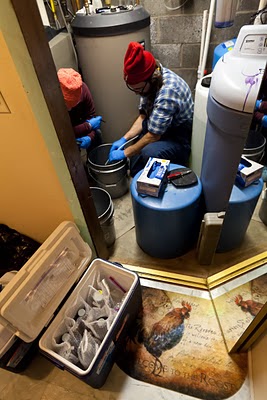
When I last visited Carter Road, a contractor for Cabot Oil & Gas was demolishing the former home of Craig and Julie Sautner, the anti-fracking activists who had relinquished their three-bedroom ranch as part of a settlement with the Texas drilling company. This was part of a larger dilemma in their hometown of Dimock, Pennsylvania, where the Sautner’s water well was polluted by nearby Cabot drilling operations, according to records from the state Department of Environmental Protection. It’s a charge that Cabot has denied publically and settled privately – with the Sautners and dozens of other plaintiffs.

The Sautner property – adorned with anti-fracking posters and inhabited by some of the most vocal and visible of fracking critics -- had become a particular symbol of the tensions that divided the community. Julie and Craig were featured in various high-profile accounts of the conflict as either victims, heroes or phonies. The aquifer that provided water to their home on 1101 Carter Road, and to 64 other homes in
EPA tecs sample water at Sautner home in 2012
Photo: JAMES PITARRESI
the area, was the focus of a controversial EPA investigation that found pollution at levels posing safety threats in 8 percent of the wells. Instead of making recommendations, the federal agency deferred to the industry’s solution, approved by the state, which was to deliver water in bottles and tanks to affected homes and provide filtrations systems. The Sautners and some other residents found those measures ineffective, and they unsuccessfully pursued a water line from the nearby village of Montrose – a measure that would have cost Cabot more than $11 million.  (A more full account of that story here.)

As part of an eventual settlement, the Sautners sold their property to a Cabot subsidiary for $167,500. Cabot demolished the vacant house, company spokesman George Stark told me after my visit last month, because the company was planning to sell the property, and it was more marketable without the
structure. Yet that answer doesn’t square with information on a deed that has since been filed in the Susquehanna County Court House in Montrose. After demolishing the house, Cabot sold the 3.3 acre parcel to Tim and Debbie Maye – owners of an adjoining property -- for $4,000. (Perhaps the absence of the house is an asset to Cabot, which retained the mineral rights on the Sautner acreage, although it’s worth noting that the DEP has forbid the company to drill in the area until it resolves the persistent problem of methane seeping into some water supplies in nine square miles around Carter Road. It's also worth noting that the Mayes have a history with Cabot that's antithetical to the Sautner's. The Mayes, who were once critical of the company, became shale gas supporters after they settled pollution claims of their own )

The most striking aspect of the sale, however, is this: The new owners of 1101 Carter Road are bound by certain conditions set forth in the deed, in parlance that may fairly be described as epic. It forbids a “residence or dwelling for human habitation” on the land. The time frame for this and other restrictions is “forever,” to be observed by future generations as “covenants running with the land.”

The sale, first reported this week by Laura Legere for State Impact, represents a kind of denouement to a story that I have been following for years while reporting for the Press & Sun Bulletin, in writing Under the Surface, and for this blog. The Sautners were initially enthusiastic and expectant supporters of shale gas development when the landman convinced them to lease their mineral rights in 2008. Their story, and the story of more than dozens others affected by Cabot’s operations, captures a complication that belies a common industry pitch:  Everyone’s a winner with shale gas development. Landowers get royalties, others get jobs, and there is cheap abundant energy for all. Claims of water contamination are exaggerated, fabricated, or trumped up by overreaching regulators.

In reality, there are economic winners and losers, as well as substantial environmental risks and trade-offs. The risks and trade-offs are hard to quantify because the industry is exempt from reporting requirements to disclose what it puts into the ground to stimulate wells, and what comes out. Whether you find this acceptable is likely to depend on whether you trust the industry more than government, your tolerance for mineral extraction in places you care about, and your belief in the wisdom of investing heavily in a fossil based energy system to meet 21st century challenges.

We know this: In some places gas is flowing, and with it, economic bounty to a mix of parties. But we also know this, like most things in life, is a circumstantial and transitory condition. The reality of the matter is that it often takes teams of bankers, lawyers, real estate agents, insurance actuaries, and regulators to sort it all out while being mindful of split estates, law suites, lease language, liabilities, and policy that can cut both ways depending on the proficiency and determination of various stakeholders. In the end, the example on 1101 Carter Road left a new land “covenant” forbidding “human habitation” at a place once called home by the Sautners.

Thursday, October 10, 2013

Western NY brine plant becomes emblem of fracking flap Town officials: negotiations between industry, DEC secret

Update Oct. 21 New York state officials will hold a forum in early November to address community concerns and questions about the status of the failed Akso salt mine and related pollution and treatment operations. Representatives from DEC and the State Attorney General’s Office will lead a discussion by technical experts at Geneseo University, Newton Lecture Building, on Nov. 6 from 6:30 p.m. – 7:30 p.m., followed by a public comments and questions. DEC spokesman Peter Constantakes said the forum is a result of concerns expressed by local officials about the future of brine treatment operations to protect water supplies in Livingston County.

* * *

Shortly after the Marcellus Shale gas boom began in 2009, a tanker truck delivered 3,000 gallons of fracking waste from a Pennsylvania drill site to a treatment plant in a rural community outside of Rochester, New York. The delivery – a drop in the bucket by shale gas standards  -- was an experiment. The plant was designed to treat waste leaching from an imploded salt mine in the Town of Leicester -- the product of a mandate from the New York DEC after the geological catastrophe in 1994.  The mine’s owner, AkzoNobel, ever vigilant of costs of the ongoing operation and ways to reduce or offset them, is now negotiating terms with the DEC to shut the plant down. Meanwhile, interested parties have considered the potential to repurpose the plant – which employs 15 people and is running far under capacity -- to receive fracking waste. In that regard, the 3,000-gallon test was a success, at least in the minds of those eager to see the plant remain in operation, or perhaps even dismantled and moved to Pennsylvania.

Some of these facts, which I confirmed this week through an informed source speaking on the condition of anonymity, are just coming to light at town and county meetings as residents try to piece together something they feel has a lot to do with their well-being: the status and future of a treatment plant that was originally built to protect their aquifer from the threats of brine leaking from a failed salt mine, and now being considered for decommission or possibly as a source for fracking waste.

The mine collapse that started it all was a major event that ruined water supplies and swallowed significant portions of the landscape. In a recent overview of the dilemma, Gannett’s Steve Orr aptly describes lingering associations:

People can't help but remember the sinkholes, land subsidence, a creek that disappeared underground and basements suddenly filled with explosive methane, the closed roads and ruined bridge that marked 1994 and 1995 in western Livingston County.

Orr also summarizes the conclusions of conflicting geological reports -- one by a U.S. Geologic Survey researcher and the other by a consultant in Albany -- regarding the consequences of shutting down the treatment operation after more than 15 years. Without the treatment, the salt will drain into a deep aquifer not currently used as a fresh water source. There is a debate whether the current quality of the aquifer justifies saving it from the discharge, and whether it might in fact be a necessary source of freshwater in the future.

It’s about the aquifer, but the DEC’s handling of the situation behind closed doors represents a broader political issue: the degree local governments trust the state’s ability, willingness, and sincerity in openly overseeing environmental protection in the face of industry interests. Perhaps nowhere is this issue hotter than with shale gas development.

Town of Leicester supervisor Lisa Semmel was among a small party of local officials who met with staff from the DEC and the Attorney General’s office last month. It was here she first learned of Akzo’ negotiations with the state to close the treatment plant, she said, but she could get details. The state officials asked her to keep the meeting confidential, she added, a request that she finds unacceptable. “We’re not keeping it quiet any longer because they are not giving us any answers,” she told me this week. “We’re kept in the dark, like everybody else.” Semmel is especially concerned about the implications of the undisclosed delivery of fracking waste at the plant – which she learned through a report last month in the Genessee Sun.

The production of shale gas from a single well produces millions of gallons of flowback  -- liquid waste that contains additives and naturally occurring hazardous substances including metals, solvents, chemicals, radionuclides, and various dissolved constituents. But its most obvious ingredient is brine, which can foul fresh water systems if not removed before the effluent is discharged into rivers and streams. Because drilling waste is exempt from federal hazardous waste laws, operators can run flowback through conventional treatment and desalinization plants not equipped to remove hazardous waste.

New York currently has a moratorium on shale gas production due to unknowns about its impacts on health and environment. But a lack of a stated policy on waste imports from Pennsylvania, an air of secrecy regarding the health department’s current evaluation of health risks, and general difficulty local officials are experiencing in prying loose information have encouraged town boards to challenge the state’s qualifications to oversee the industry in the best interest of the public. For these reasons, and questions over the state’s handling of the Leicester treatment plant in particular, the Avon Town board passed a resolution last month to re-impose a 12-month moratorium on natural gas exploration and extraction.

Avon Town Supervisor David Lefeber, quoted by Genessee Sun reporter Josh Williams, explained it this way:  “Since we talked about this operation [hydrofracking], we thought the State was going to issue permits, the State was going to monitor things, the State was going to make sure that our resources are protected … Businesses come and go, but our ability to produce food and have fresh water is a huge thing and somebody’s got to protect that.”

Avon’s resolution is one of more than 170 bans imposed or considered by municipalities statewide, and the validity of many of them rest on the outcome of a landmark case now before the state’s Court of Appeals testing jurisdictional limits of shale gas regulation known as Home Rule. (More on that here.) After five years, the state is yet to finalize its own policy on permitting shale gas development. Although Gov. Andrew Cuomo’s administration is not allowing fracking until its review is complete, it has not prohibited the importation of fracking waste from other states.

In response to my email query this week, DEC spokesman Peter Constantakes said Akso and its insurance carrier, Zurich, want to discontinue operations to treat the discharges from the ruins of the salt mine in Leicester, which they characterize as “impractical and not cost-effective,” The DEC is considering a monetary settlement for the plant’s closure, but no decision has been made. Constantakes did not address whether the plant could be repurposed for fracking waste.

Robert Middaugh, a spokesman for New York State Attorney General’s Office, said Akso is planning to dismantle the plant, and he knew of no plans to process fracking waste there. The AG’s office has been in touch with county officials about the plant’s status, he added, and has asked that only matters dealing with litigation be kept private.

Those matters could be varied, numerous, and far reaching, of course, and it’s hard to reconcile this vague answer with the claim from local town officials telling reporters they are being kept in the dark, including this in the Genessee Sun from Jim Campbell, an attorney who represents the Towns of Avon, Leicester and York:

These towns are justifiably concerned that the State and the DEC are attempting to delay this information from being made available to the public … Our concern is that the ink might already be dry on a deal between the New York State Attorney General, the DEC, and Zurich. Such a deal could have profound impacts for Livingston County and should only be considered after adequate dissemination of the facts and an opportunity for public input.

“We need a public discussion of exactly what’s going on,” Livingston County Administrator Ian Coyle told me this week. He has asked DEC officials to hold a hearing on the matter in a school or auditorium. He is still waiting for a response.

While the politically explosive option of allowing the Leicester plant to process fracking fluid may be off the table (or not), it’s hard to know exactly what’s going on behind the scenes. If the state has allowed this kind of testing for one plant, what about others? The current draft of the Supplemental Generic Environmental Impact Statement – the state’s pending overview of permitting considerations for high volume hydraulic fracturing -- identifies 130 municipal waste treatment plants in appendix 21 that have equipment that makes them eligible for fracking waste permits.

Liquid waste from gas production is just one part of a much broader metric. Shale gas development also produces solid waste, including drill cuttings tinged with varying degrees of metals, solvents, and naturally occurring radio active material (NORM) from deep in the ground. Like flowback, this waste is also exempt from federal hazardous waste handling laws, and at least four New York landfills are accepting it under protocols designed for industrial waste: Hakes Landfill in Painted Post, the Chemung Landfill near Elmira, Seneca Meadows Landfill in Waterloo and the Allied/BFI Waste Systems landfill in Niagara Falls. According to figures compiled by Fractracker (which compliles industry reports filed with the state) operators in Pennsylvania imported 29,662 tons of solid waste and 6,000 gallons – a relatively small amount -- of fracking fluid to New York destinations in the first half of 2013.

There are incentives and rationale for accepting waste from shale gas operations: It has to go somewhere; it is an unpreventable byproduct of cheap energy that we all use; it is not perceived as dangerous; it is handled appropriately and sufficiently as industrial waste; and it can generate millions of dollars of revenues for municipalities and private companies as part of the larger economic incentive for shale gas development.  But given the tenacious and organized resistance that has stalled fracking in New York, it will be a hard political sell for most New York communities to knowingly allow the importation of Pennsylvania fracking waste under incomplete and seemingly discretionary state policy and it’s growing reputation for secrecy. Yet, as things stand, it remains a legally viable option, one that does not require public hearings, and one that is difficult to track.

Wednesday, October 2, 2013

Duke study finds radioactive hot spots in PA tributaries Levels below shale discharge 200 X above background


Radioactive waste discharged into rivers from shale gas operations in Pennsylvania exceed regulatory thresholds and pose an environmental risk, according to a study released today by Duke University.

The peer-reviewed study, published in Environmental Science and Technology, found that radium levels of sediment samples collected in Blacklick Creek downstream from a treatment plant in Western Pennsylvania were 200 times greater than samples upstream and background sediments. The levels exceed thresholds for radioactive waste disposal and pose “potential environmental risks of radium bioaccumulation in localized areas of shale gas wastewater disposal.” The samples were collected downstream from discharges from the Josephine Brine Treatment Facility, in Indiana County, which treats wastewater from oil and gas drilling.

Waste from oil and gas drilling is exempt from both federal hazardous waste handling and disposal regulations and the Safe Drining Water Act. Oversight is left up to states, including New York and Pennsylvania, which have no standards or protocol to test drilling waste for radio-active material. The Duke study is sure to heat up a debate in both states over health risks from extracting shale gas through high volume hydraulic fracturing. Researchers attempting to clarify the issues face a tall task due to a lack of public records and disclosure about chemicals used and waste produced. The Duke study is one in a small but growing field attempting to quantifying environmental hazards of shale gas development -- a key requisite for gauging health risks. It will likely take years if not decades for answers that carry the weight of science, and even those will likely be debatable without mandatory disclosure requirements for the industry.

Currently, at least five landfills in upstate New York accept drilling waste from Pennsylvania drilling operators: Hyland in Angelica, the Hakes Landfill in Painted Post, the Chemung Landfill near Elmira, Seneca Meadows Landfill in Waterloo, and the Allied/BFI Waste Systems landfill in Niagara Falls. Landfill waste includes cuttings and mud from well drilling. Although it’s different from the effluent discharged into streams, it also tends to include high levels of radium.

The Pennsylvania DEP tested water downstream of some wastewater treatment plants in late 2010, and found levels to be at or below background. Tests by the Pittsburgh Water & Sewer Authority also showed no  excessive readings at intakes to its treatment plant on the Allegheny River near Aspinwall. But other studies, including one by the USGS, showed that radio-active levels tend to correspond with shale gas waste, and that tends to fluctuates depending on operators production and disposal schedules.

As a follow-up, the DEP announced earlier this year a plan to sample and analyze the naturally occurring radioactivity levels in flowback waters, treatment solids and drill cuttings, as well as associated matters such as the transportation, storage and disposal of drilling wastes “at dozens of sites.” DEP spokeswoman Colleen Connolly said today that results of the study, which is underway, will likely be available early next year.

The following is from a SGR post on Feb. 2, 2013, which is relevant in light of the Duke study:

Reports about radioactive production waste from the Marcellus Shale have been circulating for years, but in the absence of public oversight and testing protocols, they are hard to gauge. A report by the USGS in 2011 found that high radium levels correspond with saltiness and total dissolved solids (TDS), all of which are characteristic properties of waste from Devonian shales, including the Marcellus and Utica formations underlying parts of New York, Ohio, Pennsylvania, West Virginia and Maryland. TDS is a measure of concentration of salts and other impurities dissolved in water. They are not visible to the naked eye, and they are flags for water problems apart from radioactivity. 
Concerns over hot fracking waste are not new, and they are not limited to Pennsylvania. While reporting for Gannett, I uncovered a 2008 memo from the New York State Department of Health to the Department of Environmental Conservation warning of the dangers of radio-active flowback. The memo, unreleased to the public, referenced an analysis of wastewater samples by state health officials that found levels of radium-226, and related alpha and beta radiation up to 10,000 times higher than drinking water standards. Based on that finding, the Health Department urged the DEC to design a testing protocol to ensure hot drilling waste is handled and disposed of properly. "The issues raised are not trivial but are also not insurmountable," the memo concluded. "Many can be addressed using common engineering controls and industry best practices."
That is reassuring, to a degree. But what are “best practices,” exactly, and how effective are they if they are optional? For now, they are left to the discretion of operators who assure us that all is being handled properly, and to private waste plant operators who echo these reassurances.

Saturday, September 28, 2013

NY’s fracking future hinges on opaque health review Process clouded by secrecy, group sues to open records.


It was one year ago that state officials added a twist to the protracted controversy over whether and where to allow fracking in New York. National news reports in August and September of 2012 suggested that a decision to permit fracking in certain areas was imminent by or shortly after Labor Day. Labor day came and went, and instead of a decision on fracking, we got an announcement from DEC Commissioner Joe Martens that he would ask the health commissioner to assess whether the administration’s four year environmental assessment on which permitting would be based had sufficiently covered the potential for health problems. To do this, the Department of Health hired three outside specialists to critique the state’s draft review – a 1,500-page document called the Supplemental Generic Environmental Impact Statement - -and make recommendations about where to go from there.

The dilemma in New York, which sits over the Marcellus and Utica shales, is emblematic of a global controversy involving future energy sources, the economy, and public health: Is fracking safe and how do we know?

Now, a year after Martens announced the health review, things are no clearer, and in fact the health department’s involvement and ensuing events have made the outlook for shale gas development in New York foggier than ever. The Cuomo administration has released no time-frame, protocol, or scope for the health review, nor has it been willing to release records detailing the mechanics of the administrative directive. The three outside experts hired to make key assessments -- Lynn Goldman of George Washington University, John Adgate of the Colorado School of Public Health, and Richard Jackson of UCLA — are bound by contracts that include a clause prohibiting them from disclosing or discussing the proceedings or records involved.  (Their contracts expired in May, which means their work finished five months ago.)

In short, the public has been shut out of this process. The reasons for this are easily understood if not easily defensible. Over the last five years, the DEC has submitted for public review two drafts of the SGEIS, and one draft of proposed regulations. Those documents became lightening rods for criticism from anti-fracking activists, who used the formal public comment process for each to marshal an impressive display of opposition. The effort yielded protests, rallies, petitions, and (collectively) hundreds of thousands of written comments that gave the governor a taste of the anti-fracking movement’s considerable grass roots organization and effectiveness in New York, and posed a consuming work load for agency staff. Given this past result, it’s a fair guess that the administration intended the health review as a way to shore up the SGEIS’s viability, but not as a vehicle for more paralyzing public criticism. Regardless of intentions, the administration can’t keep it under wraps forever, and perhaps is already beyond the limits of its legal rights.

A process unanchored to any time line, visible policy protocol, or public framework has supported critics’ claim that the so called health review is little more than political cover for Cuomo to avoid a decision on fracking. Although complaints along these lines from both industry supporters and anti-frackers have been loud and clear, no parties have legally challenged Cuomo’s approach…  Until now.

Last week, the Seneca Lake Pure Waters Association, represented by attorney Rachel Treichler, filed a complaint with the state Supreme Court seeking a hearing on the matter in October. SLPWA is seeking state records to assess “what factual information was being collected and reviewed by DOH and the instructions given to DOH staff regarding the DOH health impact study.” The action follows the organization’s unsuccessful attempts to view records related to the study under the Freedom of Information Law.  The DOH denied the agency’s initial request on April 4 and also its appeal May 16. The grounds for the denial: the information comes under the category of “exempt intra-agency or inter-agency records,” according to the DOH response.

It’s a response that advocates find ridiculous, and the SLPWA appeal spells out why:

Frankly, it is simply not credible that the on-going DOH study of health impacts for the SGEIS does not include any statistical or factual tabulations or data, instructions to staff that affect the public, or final DOH policy or determinations. Quite simply, scientists deal with factual information. If DOH is in actuality conducting a scientific review, the factual information they are considering and the instructions to staff regarding that consideration should be released to the public.

We will soon know whether the SLPWA succeeds in prying loose information and if so, whether that will force the hand of the governor in either moving ahead with a decision or formalizing the review process. The demand to open records is supported by hundreds of members of the medical community, organizations, elected officials, and individuals. They signed a letter to the governor to open the process for public comment and to disclose “the charge that Dr. Shah gave the three outside reviewers who are assisting him and to view the documents that they have been given.” But I have also heard off the record from some fracking opponents who fear efforts to press Cuomo could backfire by changing a dynamic – the governor’s indecision - that has so far worked in their favor by preserving the status quo.

Some fracking supporters feel a more transparent health review will also work in their favor, and for this reason they are encouraging their adversaries’ efforts. A blog, Flare Alert, posted by the firm of industry attorney Tom West, anticipated this result of the SLPWA complaint:  “If this suit is successful, it may provide the pressure needed to put an end to this otherwise unnecessarily protracted process. The alternative appears to be a further delay of the determination by the administration until after the 2014 gubernatorial election.”  Karen Moreau, executive director of the New York State Petroleum Council, said in a forum at Albany Law School this week that a lack of transparency disserves the public, and that she “applauds the group from Seneca Lake” suing to open the health department’s review.

Although the health review remains vague, the Cuomo administration has selectively released documents that suggest where the administration stands. Their tone has been vague and cautious, but they generally support the notion that Cuomo has no intention of permitting shale gas wells without a faithful attempt to gauge health impacts, and that the decision by other states to proceed without this assessment is folly.

This was the theme of a two-page memo released to the press on Feb. 12 from DOH Commissioner Nirav Shah to DEC Commissioner Joe Martens.  Shah advised that he expected to make a formal recommendation “within a few weeks.” In the meantime, the DOH staff was reviewing three studies evaluating the impact of fracking on public health elsewhere. They include a federal EPA evaluation of risks to groundwater, and two studies evaluating public health indicators in Pennsylvania gas fields, including one by Geisinger Health Systems that will evaluate hundreds of thousands of records of patients. It will be years before the studies are complete, and Shah did not explain how DOH staff might be able to glean useful information from them “within a few weeks.” Although most of us take that phrase to mean 14 days or less, in the place that produces New York policy, it can mean something other than that, and the tone of Shah’s memo to Martens in fact suggested a much longer delay:

The time to ensure the impacts on public health are properly considered is before a state permits drilling. Other states began serious health reviews only after proceeding with widespread HVHF.
In my view, that is not the right approach for New York to take if we are serious that public health is the paramount question in making the HVHF decision. And as Health Commissioner, protecting the public health is my primary job.

He concludes the letter:

From the inception of this process, the Governor's instruction has been to let the science determine the outcome. As a physician and scientist, I could not agree more. Whatever the ultimate decision on HVHF going ahead, New Yorkers can be assured that it will be pursuant to a rigorous review that takes the time to examine the relevant health issues.

A noteworthy figure in this is Richard Jackson, the UCLA health specialist hired to review the state’s work. He has pointed out in his lectures that it's virtually impossible to produce energy without affecting health, pro and con, and trade offs must be known, documented and considered. Although Jackson's contract with the state has expired, Jackson is said to be continuing on a pro bono basis, according to a report from Gannett’s Jon Campbell. And while Jackson is forbidden to talk specifically about the state study, during a webcast earlier this year he generally urged health impact assessments – lengthy formal reviews that include public participation, time-lines and scopes -- for states considering fracking operations: “We need to step up and be much more visible and present and we need to assure that there is a health impact assessment on any proposed hydraulic fracturing or drilling process just as there would be an environmental impact assessment.” (Some of Jackon's specific comments about fracking on his webcast and his overall involvement with the NY's health review was harshly criticized by a group of health professionals for other reasons. More on that here.)

There are many complicating factors, not the least of which is independent funding. At Geisinger, several pilot studies have begun looking into incidences of trauma, perinatal outcomes, asthma and pulmonary disease, according to a report by Ashley Wislock of the Daily Item. But as of this summer, Geisinger had raised only $1.3 million for the first phase of the multi-year study, which is estimated to cost $25 million.

A preliminary report by a team of toxicologists from the University of Pennsylvania found that health concerns were prevalent among drilling communities: 22 percent of the participants in a small pilot study surmise that hydrofracking may be the cause of sinus problems, sleeping difficulties, and gastrointestinal problems. (Another study by the Southwest Pennsylvania Environmental Health Project, found air pollution from gas processing operations to be more of a concern than water pollution for people who felt sick from shale gas development.) But understanding the relationship between drilling and health with any degree of clarity and precision will take years. It will also take funding not rooted in special interests or at least which comes with full disclosure, and that kind of funding is getting scarce.

In short, a year after Martens announced he would shore up the DEC’s work with a health review, the scientific landscape has gotten more complicated, details of that review remain under wraps, and New York’s fracking future looks more capricious than ever. It remains to be seen whether the SLPWA demand to open records will provide a catalyst for movement, and if so in what direction.

Saturday, September 21, 2013

Will NY natural gas future break from problems of its past? DEC lacks funds to plug tens of thousands of leaky wells

Discharge from this abandoned well killed an acre of vegetation in Oneida County
The debate over natural gas development in New York has mostly been about the future. But residents living over New York’s abundant gas reserves must also figure out what to do about the past.

Regulators estimate there are 57,000 abandoned and orphan oil and gas wells statewide – many of them leaking. Of these, the state has listed 4,722 as a priority due to health and safety risks, but lacks funding to plug them. Wells tend to leak over time as casings deteriorate, raising risks of explosions and providing conduits for water contamination from methane, brine, arsenic and other pollution. The problem is summed up in this 2002 report from the New York Department of Environmental Conservation: “Abandoned wells can leak oil, gas and brine. They can contaminate groundwater and surface water, kill vegetation and cause safety and health problems. Underground leaks may go undetected for years before their damage is discovered.”

It’s a warning supported by facts in New York and neighboring shale gas states, where problems have ranged from drinking water pollution to fatal explosions. (More on that in a bit.)  Unlike many industrial hazards, abandoned wells lurk in unexpected places. (Map here.) They have been found at playgrounds and parking lots, inside buildings, in wetlands, underwater in creeks and ponds, in wooded and brushy areas and in residential yards, according to DEC records. DEC staff discovers more of them every year during scheduled inspections or while investigating complaints. The most threatening cases go on the state’s priority list to be plugged “whenever funds become available.”

So far, funds have not become available, even as the state considers plans to begin permitting new drilling on an unprecedented scale for operators targeting the Marcellus and Utica shales, extending under most of upstate New York.

The abandonment problem is rooted in the economics and regulation of gas production. As wells age and production declines, they become maintenance liabilities, which encourages their sale to whomever will buy them -- typically smaller, less established firms or even homeowners. In the end, the parties left holding them often drop them from their books or go bankrupt.

Theodore Loukides, head of the Oil & Gas Compliance and Enforcement Section for the DEC, issued a bulletin earlier this year notifying operators that “given the state of awareness surrounding energy development, the plugging of legacy wells will likely remain a high-profile issue of years to come.” In the bulletin, published in a newsletter for the Independent Oil & Gas Association of New York, he asked operators for input on plugging, and new initiatives focusing on waste, bulk storage, spills, and proper submittal of annual reports.

DEC spokesman Peter Constantakes didn’t return calls or emails about the subject this week. Yet the “state of awareness” that Loukides delicately mentions is due to the contentious issue of whether Governor Andrew Cuomo will finalize permitting guidelines for high volume hydraulic fracturing necessary to explore and produce the Marcellus and Utica shales, which collectively run under a good part of upstate New York. Since shale gas became a major political issue in 2008, the legacy of “old oil fields” is something you rarely, if ever, hear DEC officials talk about publically, even though the problem has been neatly summarized in prior studies and annual reports.

The 1995 annual report for the Minerals Resources Division was explicit in this warning ,which was repeated verbatim almost a decade later in a 2003 report commissioned by the state Energy and Research Development Authority:
One of the biggest challenges facing the oil and gas regulatory program is the growing liability of idle and abandoned wells. In most cases financial security, even for operators in compliance with current regulations, does not provide sufficient funding to plug the covered wells. When operators default on their tax bills and counties foreclose on properties that contain unplugged wells, those wells become a liability for local taxpayers. This is not a hypothetical worst-case scenario, but reflect current events already happening in the counties. We need a creative approach to develop new solutions to this problem, and hope to productively work together with all stakeholders in this effort.

Fixing the problem will require significant regulatory reform, according to Ron Bishop, a professor of chemistry and bio chemistry at SUNY Oneonta who has been studying the orphan well issue in New York. In a white paper for a land preservation group called Sustainable Otsego, Bishop explains:

Unless the state of New York does something to dramatically alter the long-standing culture of neglect, we can reasonably expect oil and gas industry operators to ignore any new standards just as they systematically ignore existing standards today. 

The problem extends from the pre-regulatory era to current times. It’s common practice for larger operators to sell off wells near the end of their life cycle to smaller firms with less capitol. The sale provides the seller with a better financial outcome than holding onto the dwindling returns and provides a buyer – typically one with limited capital -- a well that it doesn’t have to drill. Bishop cites this explanation from Lou Allstadt, a former senior executive with Mobile Oil:

The original company uses the cash to finance new investments. The buying company operates with lower costs because they spend less on maintenance and safety items and they have fewer well-qualified people to pay. The chain may end there or continue through smaller and ever lower cost operators who do no preventive maintenance at all, do the bare minimum of repairs to keep the well going and eventually walk away, maybe after plugging the hole as cheaply as possible and maybe not plugging at all. The smaller companies often operate each well or group of wells under a separate corporate entity that is always stripped of cash, so if something goes wrong there are no assets to pay off claims. Not all small operators will do this, but it happens. 

Shale gas wells are more prone to this outcome than yesterday’s conventional wells because production from shale, known as tight gas, tends to taper more quickly than conventional wells, according to Bishop.

Now for more on the legacy of problems in New York and Pennsylvania: A starting point is in 2008. The first wave of aggressive shale gas prospecting in New York raised many questions with residents, and DEC staffers staged informational meetings at town halls throughout the Southern Tier to address them. Officials from the Minerals Resources Division pitched shale gas as a clean, problem free and well-regulated industry. They avoided mention of the tens of thousands of orphan wells that in fact represented a serious, chronic, and concrete problem.

Around this time Walter Hang, an environmental researcher, began uncovering a history of neglect that undermined the DEC’s message and sowed early seeds of public doubt about the transparency of both the industry and those who oversee it. Hang is president of Toxics Targeting, a firm that identifies and tracks pollution liabilities for developers and municipalities.

Hang and others who tried to quantify and characterize the problem had tough going, due to a records system that was decentralized, archaic, and often incomplete with files scattered among disparate government offices, private companies, and court rooms. Still, Hang culled 270 records documenting mishaps —some from newspaper clippings, dossiers at health departments, complaints filed with elected officials, and some showing up on the DEC’s database for spills. Many of the problems -- including fires, blow-outs, methane migration, and spills relating to wells or infrastructure –- remained unresolved and partially documented.

Hang’s analysis, which I wrote about in a series of reports for the Press & Sun-Bulletin and later in Under the Surface, drew sharp criticism from industry and regulators who dismissed it as overblown.  A few hundred cases, they said, represents a negligible proportion of the tens of thousands of wells drilled through New York’s history. Still, the cases were troubling then and they are troubling now, mostly because they represent a subset of a greater number of problems that will remain unknown without a reliable and comprehensive system to document them.

In matters of transparency, the oil and gas industry operates mostly on its own terms.  It works on private land under contract with landowners. Chemicals pumped into wells are exempt from the Safe Drinking Water Act, and waste that comes out is exempt from federal hazardous waste laws. The absence of a federal regulatory baseline in these two critical areas leaves a lot of grey area.

And it gets greyer. The DEC, like other states, adopts a laissez-faire approach to much of its oversight.  Agency’s are understaffed and rely primarily on paperwork submitted by operators. Complaints involving water contamination are often settled privately between leaseholder and drillers, and they often end with non-disclosure agreements that eliminate any public paper trail.

William T. Boria, a water resources specialist at the Chautauqua County Health Department, was frustrated by this very approach.  He reported his agency had received more than 140 complaints related to water pollution or gas migration associated with nearby drilling operations. “Those complaints that were recorded are probably just a fraction of the actual problems that occurred,” he stated in a 2004 memo summarizing the issue. For fifty-three of those cases filed from 1983 to 2008, county health officials tabulated an informational spreadsheet that cited methane migration, brine pollution, and at least one home evacuation resulting from a water well explosion. “A representative I spoke with from the Division of Minerals [of the DEC] insists that the potential for drinking water contamination by oil and gas drilling is almost nonexistent,” Boria wrote in his memo to a party whose name was redacted. “However, this department has investigated numerous complaints of potential contamination problems resulting from oil and gas drilling.”

The problem is worse in Pennsylvania, where 200,000 or more abandoned wells are more or less hidden under the landscape. In September, 2009, the DEP compiled a draft of known cases where methane leaked from abandoned or working wells.  According to the briefing, methane migration from gas drilling, had “caused or contributed to” at least six explosions that killed four people and injured three others over the course of the decade preceding full-scale Marcellus development. The threat of explosions had forced 20 families from their homes, sometimes for months. At least 25 other families have had to deal with the shut-off of utility service or the installation of venting systems in their homes. At least 60 water wells (including three municipal supplies) had been contaminated.

What does this mean for the future? It’s hard to know where to start, but focusing on the cost of the problem is a good place. Plugging a single well can cost between $5,000 and $50,000, according to estimates from the DEC. That means the bill for dealing wells on New York’s priority list alone would cost between $24 million and $236 million. In economic terms, this cost is “externalized,” which means that it is not borne by businesses or their consumer. Rather, it’s falls to taxpayers, or comes at the expense of public health and safety.

In many ways the orphan well legacy is similar to the abandoned mine legacy that continues to foul water and create public hazards in Pennsylvania and other states, and it’s a manifestation of an important aspect of the extraction industry overall. Coal, natural gas, and oil provide modern-day comforts beyond historical comparison. As energy consumers, we should embrace a moral obligation to understand where our energy comes from and at what cost as we evaluate tradeoffs.

Monday, September 16, 2013

New study: EPA on target with estimates of methane leaks PNAS offers latest contribution to controversial field

(Updated Sept. 17 with statement from Cathles and link to Dot Earth post. Updated Sept. 18 with link and reference to Steve Horn’s report of industry connections to the study.)

The latest in a string of studies gauging the volume and impact of methane leaks from shale gas development supports the validity of current estimates by the federal government to direct policy.

The peer review study released Monday afternoon by the Proceedings of the National Academies of Science reports direct measurements of methane emissions at 190 onshore natural gas sites in the United States. The report found:

Total emissions estimated based on measurements in this work (2,300 Gg) are comparable with the most recent EPA national GHG inventory (2,545 Gg) in the 2011 inventory, released in April 2013.

The PNAS study represents a collaboration between the industry, the Environmental Defense Fund, and academic teams from the University of Texas, Arizona State, Temple, Berkley and other institutions. It found that lower-than-expected leaks at specific shale gas well sites were largely offset by greater-than-expected leaks elsewhere in the gas processing and transmission system:

The measurements indicate that well completion emissions are lower than previously estimated; the data also show emissions from pneumatic controllers and equipment leaks are higher than Environmental Protection Agency (EPA) national emission Q:8 projections. Estimates of total emissions are similar to the most recent EPA national inventory of methane emissions from natural gas production.

The report will surely stimulate controversy on the critical issue of whether natural gas is an effective means to transition away from energy sources that exacerbate climate change, and whether the federal government is armed with enough information to oversee the industry. Natural gas burns cleaner than coal, with less carbon and virtually no particulate matter and other toxic pollutants, such as mercury. But methane is a potent greenhouse gas, especially over the short term. (Oil and natural gas production also releases hazardous air pollutants  -- HAPs --  and volatile organic compounds -- VOCs -- which are not the focus of the study.)

To help inform policy, scientists are making new efforts to gauge how much unaccounted methane leaks into the air at wells, pipelines and processing stations, and what the impact is. According the PNAS study:

These measurements will help inform policymakers, researchers, and industry, providing information about some of the sources of methane emissions from the production of natural gas, and will better inform and advance national and international scientific and policy discussions with respect to natural gas development and use.

(Questions related to the industry’s impact on air are distinct from policy issues related to water pollution. The natural gas industry is exempt from federal laws that govern chemicals injected into the ground, and how the waste that flows back from wells is handled and disposed of.)

The PNAS study is one of several that have emerged in the last two years in the wake of a paper by Robert Howarth and Anthony Ingraffea that found natural gas is not as clean-burning as advertised. Howarth, a climate scientist at Cornell University, has been involved in the discussion of methane’s impact on air since it became a pressing national issue with the advent of the domestic shale gas boom enabled by horizontal drilling and high volume fracking. Howarth and his Cornell colleague Tony Ingraffea essentially kick-started the debate in 2010 when they published a controversial paper challenging conventional wisdom that natural gas production was less of a warming threat than coal.

The topic was again in the news earlier this year when a study by the National Oceanic and Atmospheric Administration in the Uinta Basin in Utah suggested that benefits of natural gas production were offset by excessive methane leaks in the system. Climate change reporter and author Andrew Revkin offers an excellent history of the discussion – along with comments and reaction from academic stakeholders on both sides of the debate -- in his recent post for New York Times Dot Earth.

Howarth characterized the findings in the PNAS paper as representing a “best case scenario” of methane leakage because the measurements were taken only at places where industry allowed access for researchers. By comparison, the Utah study was derived from observations and measurements collected by equipment on planes that flew over broad areas, rather than relying on access to individual sites granted by industry.

The PNAS paper “is not representative of what industry is actually doing, but what it wants to be,” Howarth said. Still, he added, the study is an important addition to the small but growing body of knowledge on the extent and impact of methane leaks.  “It’s a new science, and I’m impressed with what they have been able to do in this short time frame,” he said.

Lawrence Cathles, a colleague of Howarth at Cornell who argues the climate gains from natural gas development outweigh the losses, said it was not feasible that industry could hide or disguise the volume of methane emissions. “Actually, we will know immediately, and in plenty of time to do something about it, if industry is deceiving us,” he said in a statement that can be viewed here. “In order for methane to contribute to greenhouse warming it must increase dramatically in its atmospheric concentration, and this will be easy to notice.

As expected, industry's ties and involvement with the study were immediately challenged by critics upon its release. The Public Accountability Initiative, a watchdog group, issued this statement:

The failure to disclose the significant conflict of interest of one of the authors, Jennifer Miskimins, appears to constitute a violation of PNAS's conflict of interest policy. Miskimins is listed as a professor at Colorado School of Mines in the article, but has been an employee of Barree Consulting, an oil and gas consultancy offering fracking services, since 2012 -- prior to the submission of the study to PNAS. 
The disclosure failure may warrant an erratum or possible sanctions on the authors of the study, according to PNAS rules. PNAS's conflict of interest policy is here: http://www.pnas.org/site/authors/coi.xhtml
A day after this assessment, Steve Horn, writing for DeSmog Blog, reported that nine members of the 11-person steering committee overseeing the study have direct ties to industry interests. You can find the list and the rest of Horn's post here.